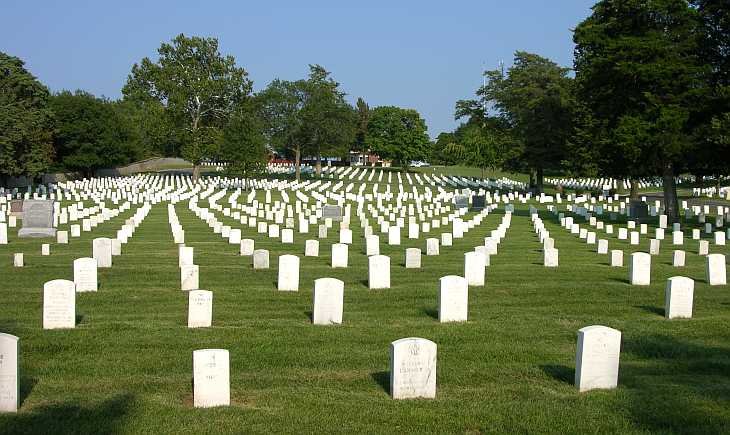
In the spring of 1970, my father heard one of the neighborhood kids had been killed in Vietnam. Jim Varansky, by all accounts, was a good kid and a hard worker who joined the Marines to support his mother and younger sisters.
Shortly after becoming a Methodist minister, my father sat down and wrote a sermon laying out the waste, futility and uselessness of war. For more than 40. years, my father gave that same sermon every Memorial Sunday, always perfecting and updating it as time went on.
My father passed last winter. Given recent events, and in keeping with his custom, I felt his signature sermon deserved an update. . . by adding just a single word.
Cheers, Tears, and Fears
If any day ever called us to straight-thinking, fact-facing, and high-resolving, it is Memorial Day. This day was first instituted to decorate the graves of those men who had fallen in that bitter, pathetic and tragic internal strife known as the Civil War.
It was soon expanded to include a memorial for those who, along with General Washington, wielded the sword that cut the natal cord that bound us to the Mother Country; then again enlarged to remember those who answered the call of their country to liberate the little island of Cuba from a tyrant's yoke, and in later years, once more enlarged to include the boys who lost their lives in a war to end all wars, World War I.
Then World War II. Then Korea. Then Vietnam. Then Grenada. Panama. Kuwait. Somalia. Bosnia. Afghanistan. Iraq. Iran.
As much as we hate war, to say there is no call for Cheers, as we think of the array of slain men and women is to fail to appreciate the motives and ideals for which they laid down their lives. God forbid that I should utter one word in commendation or glory for that hideous and barbarous practice of war; which unsettles more than it settles; which often seems to give men or nations a new freedom, but always binds those who are left with debt and hatred that crush and curse to the third and fourth generations; which often has seemed to solve a dispute which could not have been solved otherwise, and yet, after much property has been destroyed and many slain on both sides, then they gather about a peace table to do what should have been done in the first place.
Nevertheless, let us render honor, not to the practice of war, but to the men, women, boys and girls who paid their last full measure of devotion. In one or another of these groups was one who was from your family or mine.
Some of us have visited Lexington and Concord and crossed that bridge and seen those stone walls from which were fired the first shots that were heard around the world. And some of us have walked over the battlefield at Gettysburg, where my feelings were so mingled that I dare not analyze them as I walked among those thousands of headstones. Was there not a better way?
I remembered that history tells us that a member of Congress from Illinois proposed a peaceable, bloodless way to emancipate the slave, thus removing the cause of this section dissension; but no, they could not heed the voice of a peacemaker.
I wept as I walked through those grave-strewn hills. Never before had I felt the true meaning and pertinence of the great Lincoln’s words as he stood there while those graves were still new, and out of his aching heart, he poured two immortal utterances; “We cannot dedicate, we cannot consecrate, we cannot hallow this ground. The brave men, living and dead, who struggled here have consecrated it above our poor power to add or detract” and “that we highly resolve that these dead shall not have died in vain.”
Cheers, yes. For the Blue and the Gray. For the men who answered McKinley’s call to free Cuba and offered their lives in that conflict deserve our honor. And they have it. And then the struggle that involved the entire globe, and many cheered as the young men marched off to die horribly in the muddy trenches of France, and some to return home maimed, blind, and broken. But it was for a good cause, it was a war to end all wars.
And then World War II. Korea. Vietnam. Grenada. Panama. Desert Storm. Somalia. Bosnia. Afghanistan. Iraq. Iran.
But half has not been told; for every casualty in the procession of war dead, there are parents, a spouse, a sweetheart left empty. Too often they are forgotten. We’ve had the cheers for the soldiers, but we have withheld our tears for those who are sentenced to a living death. No Memorial Day is fittingly observed if we have cheers for the men and boys and not tears for their mothers, wives, and sweethearts.
One reason war has perpetuated from generation to generation is that it is paraded in uniforms, accompanied by marching music glorifying its honored dead. If it was represented as it really is — hate, mud, blood, agony, death, debt, taxes, poverty, broken homes, and broken hearts — war would be robbed of its fancied glory. If on every Memorial Day, we could have a parade through every street of every town and village, of the crippled, the insane, the maimed, the marred, the scarred, the blind, and the shell-shocked, and their mothers, wives, orphans, and sweethearts. We have put in the cheers and we have done well to do that, but too often we have left out the tears, and that is unwise, unfair, untruthful, and unsafe.
Let us not forget the tears this Memorial Day.
And what concerns us even more than the past is our future. Cheers for the nation’s heroes, tears for the parents, spouses, and sweethearts. But what about our children and grandchildren? Will it be fears?
It is a grave mistake if we celebrate with our eyes turned only on the past, with no eyes turned toward the future. I can hear those honored dead saying to us, “Weep not for us, but weep for yourselves and your children.”
So, I ask that we resolve that these honored dead shall not have died in vain. They did not die so that there could be more wars, more weapons, more debts, more sorrow, more blasted hopes. They died that the world might be better, there might be peace, a world where little boys might grow to maturity and not be taken by his nation and sacrificed on the altar of Mars; a world where little girls might grow up to love those fine boys without having them snatched away, leaving them with aching hearts and empty arms; a world where nation shall not rise up against nation, and neither shall learn war no more.