Editor’s note – Historical information for this article was gleaned from a variety of sources, including the Remember Pittsburg site online.
PITTSBURG, Kan. — On a spring day late in May 1876, Colonel E.H. Brown stood on a patch of ground in southeast Kansas. Brown, a surveyor and engineer for the Kansas City Fort Scott and Gulf Railroad, had been hired to lay out a new settlement on this barren piece of prairie.
What brought Brown to this spot was a series of events that started in the years following the Civil War. Although construction of the transcontinental railroad began before the war, it was not until afterward that construction kicked into high gear. With one line headed west out of Kansas City and another headed east out of San Francisco, the two finally met at Promontory Point, Utah, in 1869.
From this main line, spurs began spreading to the north and south. The southern arms stretched across Kansas for the Oklahoma border where they were met my cowboys driving Texas cattle north for shipment to Kansas City, Omaha, and Chicago. These railroads also brought in new settlers, supplies, and merchandise.
In 1868, Crawford County was established in Kansas from the southern third of Bourbon and northern third of Cherokee Counties with its county seat, Girard, situated in the middle of the county. During this time, construction of the Kansas City Fort Scott and Gulf Railroad (KCFSGRR) was making its way through Bourbon and into Cherokee County, reaching Columbus and Baxter Springs in 1870.
Across the border in southwest Missouri, two men, E.R. Moffett and J.B. Sargent, were making their fortune mining zinc and lead, using their newfound wealth to establish the city of Joplin in 1871.
Before long, Moffett and Sargent were looking for a way to connect their zinc and lead mines to the KCFSGRR in Cherokee County. They enlisted the help of another investor, Franklin Playter of Girard, to secure financing for a new railroad to connect Joplin to the KCFSGRR. Playter, a Canadian-born resident of Crawford County since 1868, knew of the coalfields in southeast Crawford County and convinced Moffett and Sargent to build their railroad between Joplin and Girard.
In 1875, Moffet, Sargent, and Playter began buying up land between Joplin and Girard for the new railroad, including a 160-acre plot for a new town that would act as economic center of southeast Kansas. They hired Brown to conduct the survey and lay out the new town.
Brown’s initial plan for the new town was a simple grid, one-half mile by one-half mile centered on the intersection of Fourth and Broadway Streets. The city was divided into 48 blocks, extending from First Street in the south to Seventh Street in the north; and from Joplin Street on the east side to Olive Street on the west. Each man — Moffett, Sargent, Playter, and Brown — took control of one quadrant of the new town, agreeing to erect a building on their parcel of Fourth and Broadway. Moffet and Brown elected not to do so as the intersection was considered a loading area, but Playter and Moffett did.
On the southwest corner, Playter erected a wood-frame general store to be operated by his brother-in-law, W.G. Seabury, and stocked with goods from his store in Girard. For his part, Moffett built a wood-frame pharmacy on the northwest corner. In 1877, it was sold to Swedish immigrant John Lindberg who replaced the wooden structure with a brick one but kept the pharmacy, operating it from that location for the better part of the next 100 years.
From the beginning, Playter had big plans for this new town. He imagined it as the industrial heart of Crawford County and southeast Kansas. With such lofty ambitions, the town had to have an appropriate name — Pittsburg, in honor of the steel capital of Pennsylvania.
But there was a problem.
William A. Pitt had already established Pittsburg, Kansas in Mitchell County in 1871, so Playter called his new town New Pittsburg. Playter offered Pitt money to change the name, but Pitt refused. According to the City of Tipton, a purse of $150 was finally accepted by the city to surrender the name Pittsburg and take the name Tipton, after the county seat of Cedar County, Iowa, from which one of the city leaders originally hailed.
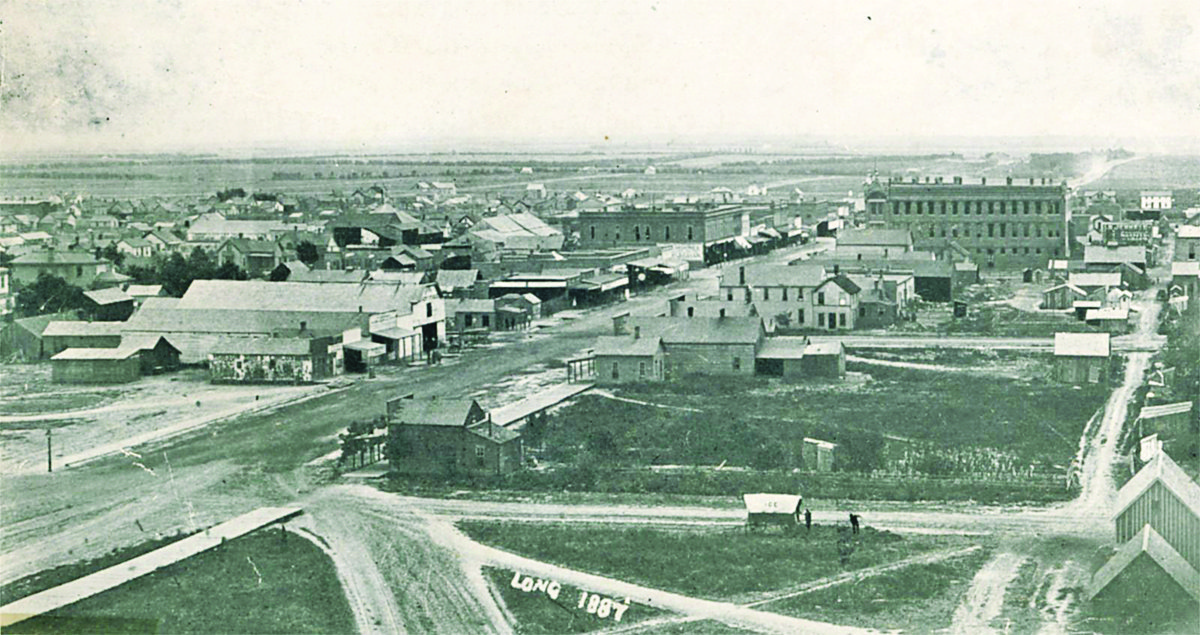
Despite the dispute over the name, Pittsburg grew rapidly. By the end of 1876, the population had already grown to 100 residents. Before the end of the city’s first decade, William G. Cutler noted in 1883, that Pittsburg coal mines were producing up to 100 carloads per day, three zinc smelters in operation with a fourth under construction as it took three tons of coal to melt one ton of ore, it was cheaper to ship the ore to the coal than the coal to the ore.
Schools and a post officer were opened. The city’s first newspaper, The Pittsburg Exponent, hit the presses in 1879 before being sold a year later to the Flint Brothers of Girard and renamed The Pittsburg Smelter in 1881.
Cutler wrote in his “History of the State of Kansas” that Pittsburg, in 1883, “has a population of 3,500, and contains eight general stores, one exclusive grocery, three hardware, four drug, and two shoe stores, one clothing store, four meat markets, two shoe shops, two blacksmith shops, three millinery stores, one furniture store, three lumber yards, six hotels, one merchant tailor, two livery stables, two churches, one harness shop, etc. The Pittsburg flouring mills were established in 1881, by Bruner & Warren. The building is a three-story frame building, and contains three run of stone. The capacity of the mill is fifty barrels of flour per day. The power is a twenty-five horse power engine.”
Harold Bell Wright commented when he arrived in Pittsburg in 1898: “There were 14 denominational churches and not a place except saloons, gambling houses, and houses of prostitution where a man might spend a leisure hour. Saloons in a prohibition Kansas city? Yes, twenty-three of them – not blind but wide open, with beer signs at the entrance, swinging doors, bar and everything. Beer wagons drove openly in the streets”
By 1905, it was noted in “A Twentieth Century History and Biographical Record of Crawford County, Kansas” that Pittsburg “in a few years had grown from a plat of bare prairie to a city of fifteen thousand inhabitants, with all the modern conveniences. Five railroads carry her commerce. Four wells, reaching to a depth of from twelve hundred to fifteen hundred feet, furnish an abundance of pure water. The trolley cars of the Pittsburg Railroad Company, extending to Frontenac on the northeast and Chicopee on the southwest, making a continuous line of ten miles, furnish the transportation to the people; while the railroad shops of the Kansas City Southern Railway, with the many other manufacturing establishments, furnish employment to her people.
“In her push for business the wants of the traveling public have not been overlooked. The Hotel Stilwell was erected in the year 1890, and is one of the finest hotels in the west. It is kept by O. K. Dean, who caters bountifully to the wants of his guests. Other hotels are the Crescent, on the corner of Third and Locust, Commercial, Third and Broadway, Phoenix, Fifth and Locust, and other smaller ones scattered over the city.”
Pittsburg’s rapid growth attracted other businesses as well. Although known for coal, the demand for brick brought several foundries to the city, including Dickey Clay Products, to fire brick for the Stilwell and Bess Hotels, among other structures.
Though the city has been through some hard times, it has always weathered the storm. What R.E. Carlton wrote in 1915 was as true then as it is today:
“By a steady and prosperous growth the town soon became a city. That the forethought and enterprise of Pittsburg’s early citizens has been taken up and carried on by the later generation is apparent by the prosperous Pittsburg of today.”