By allowing ads to appear on this site, you support the local businesses who, in turn, support great journalism.
Sen. Moran visits Mercy Hospital Pittsburg
Hospital receives federal funds
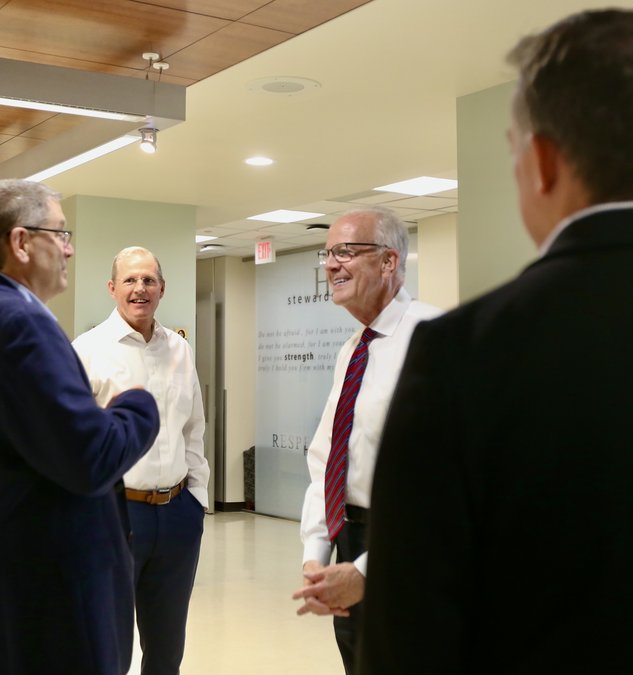
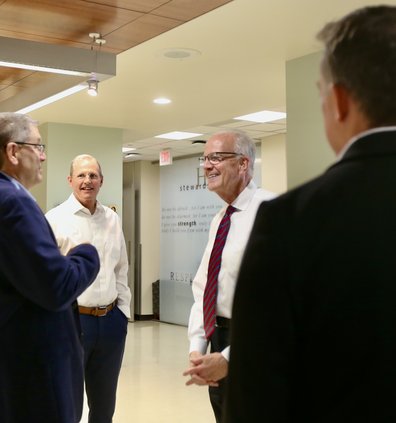
U.S. Senator Jerry Moran, (R-Kansas), second from right, talks with Mercy Hospital Pittsburg Administrator David Smith, Pittsburg City Manager Daron Hall and Pittsburg Area Chamber of Commerce President Blake Benson during a visit to the hospital Friday morning. - photo by Aaron Pyle

PITTSBURG, Kan. — U.S. Senator Jerry Moran, (R-Kansas), spent his Friday morning traveling through the Crawford and Cherokee County regions, stopping by Mercy Hospital Pittsburg before making his way to Weir to understand its operations, struggles, and to ask “what do you need.”

He was also on a mission to highlight the first disbursements in the Rural Health Transformation Program (RHTP). Mercy Hospital Pittsburg will receive $681,711 from the Regional Partnerships Grant Program (RPGP), a part of the RHTP, according to the Kansas Department of Health and Environment (KDHE).

Overall, Kansas will receive $222 million in the program’s first year, making the state the sixth-highest recipient. Over the next five years, Kansas providers are estimated to receive approximately $1 billion from the RHT Program.

Moran played an integral part in the creation of the RHTP, establishing the program in last year’s reconciliation bill, also known as the Working Families Tax Cut.

In Pittsburg, Moran was welcomed by city representatives, chamber representatives, hospital board members, and hospital staff members before going on a tour of the facility, with special focus on the emergency room.

“Hospitals and health care are hugely important to me,” said Moran. “If you look at the future of our state, and in many ways, it’s determined by whether or not Kansans have access to health care. In rural Kansas, we need to make sure hospital doors remain open, there’s physicians in our communities, pharmacy on main street, all those things help determine whether or nota community like Pittsburg and smaller towns around us have a bright future.

“I’ve visited every hospital in Kansas. I’m glad to be back here in Pittsburg ... I wanted to get a feel for what’s going on and the feel that I got is that things are really good here and they are working hard to take care of the patients in the region. In particular, I think the hospital wanted to make certain that I saw the emergency room. We are looking for federal funding to try to help this hospital expand and improve its emergency room.”

Across the state, $79.1 million in RHTP awards will go to 39 hospitals and organizations.

Mercy Hospital Pittsburg Administrator David Smith noted how the funds secured from RPGP are going to help the hospital.

“We asked for funding to become a smart hospital,” he said. “Mercy itself coming here and acquiring the hospital, it’s been night and day for this community and for care in this community. We’ve introduced a tool called Epic, which is the EMR(electronic medical record) for our hospital. Anybody here knows their MyMercy app helps them connect with Epic and information.

“We’ve done two advancements that lead to this smart hospital. One is on the inpatient side for physicians. It’s called DAX where they are able to interact with a patient, use their phone in the room and the AI will grab pertinent information ... Bring all that information in so that the documentation can happen. Why is that important? One of the things that he (Moran) talked about is that it’s hard to recruit and retain physicians.

“... This DAX piece allows them to gather that data. So instead of the three hours of pajama time at night reviewing all the documentation, it’s down about 45 minutes. One of our hospitals has been in business for 28 years, said this is the first time she’s felt a relief from the burden of documentation with the implementation of the DAX system.”

Smith provided more details on the “smart hospital” aspect.

“The smart hospital is step three where we’ll now have the equipment in 60 rooms,” he said. “There will be a large whiteboard, there will be a camera, microphones. So we are doing a lot of virtual care. They’ll be able to do documentation through the screen, we’ll be able to give you discharge information, and all the medical information so you and your loved one, when you’re in that room, you can see it, you can have that conversation, you can communicate with your physician.

“... We want you to get healthy and go home. We don’t want to see you back in anytime soon, and education on medications and your healthcare with your physician and family members is a big piece of that, too. So it’ll be very exciting to see in the next 12 months we’ll have this smart hospital at least in 60 of our rooms ... Allow that communication to happen through a neurologist, through a behavioral health person, from our intensivist in our ICU so that patient has eyes on them 24 hours out of the day, seven days a week, to make sure they are getting high-quality patient care.”

In addition to Mercy Hospital Pittsburg, a number of hospitals and organizations in the region received funds through the RHTP.  Rural Emergency Hospital Conversion/Transformative Capital Investment Grant Program Recipients included:Freeman Fort Scott Hospital ($2,502,999), Labette Health ($2,145,677), Wilson Medical Center in Neodesha ($1,555,143), and Mercy Hospital Columbus ($375,981). Regional Partnerships Grant Program Recipients included: Special Olympics Kansas ($2,546,981), Coffeyville Regional Medical Center ($2,500,000), Labette County Medical Center ($1,383,289).

This reporting is made possible, in part, by the Support Local Journalism Project Fund. Learn more at: southeastkansas.org/Localnews.