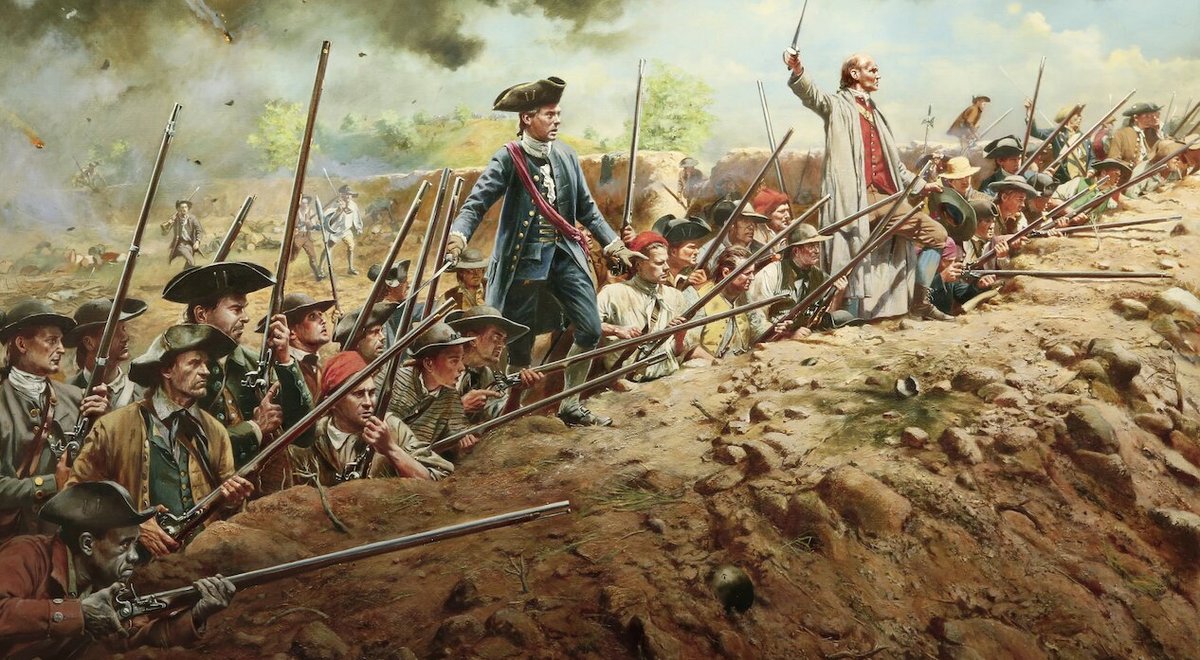
Author’s Note: Although known as the Battle of Bunker Hill, the battle was actually fought on Breed’s Hill, closer to Boston. With Washington having been appointed Commander-in-Chief just three days prior, Bunker Hill is, unofficially, the U.S. Army’s first battle.
Good tidings, Kind Readers,
It has been a busy week in and about Boston. The Old Lion, General Gage, had the audacity to offer full pardons to any Patriot who surrendered to His Majesty’s Forces, an offer of which there were very few takers as most of us are contented with making our petitions known to the King, by voice and written word preferably, but shot and shell can be just as effective.
Our esteemed militia leaders have learned they are now part of a new Continental Army to be commanded by a young Virginian by the name of Washington, who is currently enroute to take charge of our current affair.
And none too soon. For as I sit and write to you now, Fair Reader, it has been but two days since the Young Lions Howe and Clinton attempted to break out of their urban cage to set about rampaging across the countryside, no doubt.
For those who are not familiar with Boston’s geography, let me enlighten you a bit. The city proper is built on a peninsula with the only land access through the Roxbury Neck to the west. It is this neck that our militia has strangled that keeps the English lions contained. However, they are free to move about the harbor, courtesy of the Royal Navy.
To the north of Boston proper is another peninsula whose only land access is the Charlestown Neck to the north. Along the southwestern banks of the peninsula is the village of Charles Town. Between the neck and the village, down the middle of the peninsula, are two hills, Bunker and Breeds. A third, Morton’s Hill, lies along the southeastern shore.
It is on the more southerly of the central hills, Breed’s Hill, that the week’s recent drama played out.
General Artemis Ward, who is currently in command of the militia, feared the Regulars may attempt a breakout across the peninsula, which stands largely as a no-man's-land since the retreat from Concord in April. Those fears were confirmed on June 13 by a “New Hampshire gentleman of undoubted veracity" with operations set to commence on June 18.
Ward set about issuing orders to General Israel Putnam for the fortification of Bunker Hill, close to the neck, on the night of June 15. Colonel Prescott was detailed with carrying out the fortification, but, on his own initiative, decided to move further down the peninsula to Breed’s Hill as it was an ideal artillery position from which to harass Boston and the Navy in the harbor once Colonel Knox arrives with the guns from Ticonderoga.
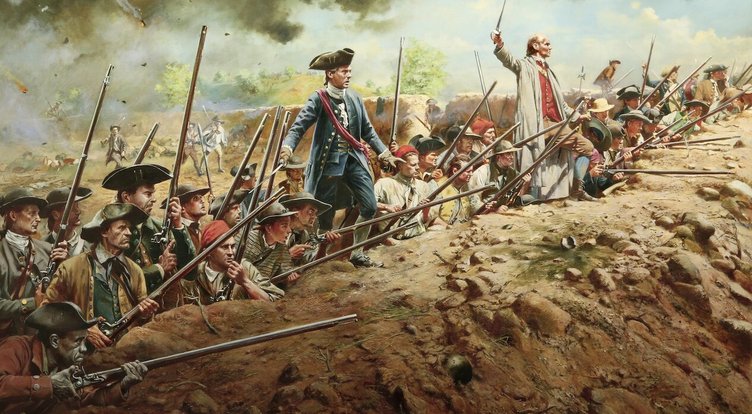
A redoubt was constructed overnight, measuring 130 feet by 130 feet, made of earth and wood six feet high, much to the surprise of the English lions at dawn. The dawn also revealed a potential weakness in the defenses as the hill could be flanked from the east. Additional breastworks were constructed on this side, extending from the hill to the waterline.
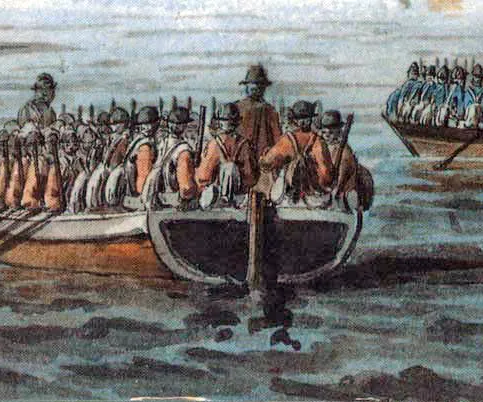
The Young Lions reacted quickly, mustering their troops and ferrying them across the harbor. The Royal Navy began a bombardment of Charlestown, setting it alight, but were unable to elevate high enough to give much cause to the redoubt. At 3 p.m., General Howe ordered the advance.
The best of British infantry — grenadiers, light infantry, and Marines — began to march up the hill, it’s crags and pitfalls hidden by waist-high hay. The militia held their fire until the British line was 50 paces distant.
In the blink of an eye, entire companies were cut down, some losing as much as 90 percent of their strength, and the attack was halted. The Regulars dressed their shattered ranks and traded fire with the militia for several minutes to no effect as the militia were in cover and the Regulars exposed on the hillside.
The order to retreat was given.
A second attack marched up the hill, the soldiers still burdened by cumbersome packs and the bodies of the dead and dying comrades. This attack fared no better than the first, as huge holes were torn in the red-coated ranks by the militia.
Again, a retreat was ordered.
Running low on powder and shot, many militiamen began falling back to the neck. Attempts were made to send fresh companies forward, but the effort proved fruitless as it appeared that there was never more confusion and less command.
The Regulars, having dropped their packs, reformed and marched up the hill a third time as the militia delivered a final volley before retreating. But the lion’s blood was up and he began such a merciless pursuit at the point of the bayonet, killing as he went along, including Dr. Joseph Warren, former president of the colony’s assembly and recently appointed major general. Warren, waiting on his official commission, had chosen to fight as a private soldier that day.
Howe claimed his victory, Pyrrhic though it was. The little lion had lost 200 dead and 800 wounded, nearly half of his men, and twice that of the militia, including over 100 British officers cut down on that hillslope by patriot muskets.
The lion returned to his cage in Boston and is contained once more — at least for now.
I pray Washington proves to be a much better lion-tamer.
Respectfully,
Alby Louder.