Southeast Kansas history lover and author, Linda Baker, is back with an 1885 story about a close call for the crew of Union Pacific No.99. — J.T.K.
With a name like “Hell’s Bend”, I knew there had to be a story. As a kid, all I knew about that area was that Dad would occasionally take us to fish off the causeway that crossed the Marmaton River there. But there was more to the story -- much more!
The year was 1885 and Engine No. 99 was running late. The train left Fort Scott about three hours behind schedule and headed south at 2 PM. It was reported to be traveling at 18 miles per hour when it approached “Dead Man’s Curve”. (Not sure how it got that name, as no one was ever killed there.)
Suddenly the engineer saw a rockslide about 150 yards ahead and reportedly yelled, “Jump for your lives!” to the crew. They did. Upon impact with the slide, the engine and four boxcars left the track. The next day, Jan. 9, 1885, when newspaper reporters went to inspect the scene, they found the engine upside down. They filed the following account of the wreck in the Fort Scott Tribune:
“One of the worst railroad wrecks we have seen for some time occurred on the Missouri Pacific, about three miles south of this city, Thursday afternoon. Freight train No. 161, pulled by Engine No. 99, with M. F. Morris, conductor; W. H. Newrick, engineer, William Britt, fireman; and Walt Carey and John Robinson, brakemen, was about three hours late. The train is due here about 10:40 a.m. but did not arrive until 2 o’clock p.m.
“They left the depot at Fort Scott, after receiving orders, and proceeded south. When they got about three miles down the road, and were about to round what is known to railroad men as “Dead Man’s Curve”, where the Marmaton makes almost a horseshoe turn, engineer Newrick, with his eagle eye upon the track and his hand on the throttle, saw about 150 yards ahead of him a tremendous land slide from the west embankment of the road. In the center of the track lay a rock that must have weighed 20 tons. The train was going at the rate of about 18 miles an hour. Fireman Britt was shoveling coal into the mammoth mouth of the furnace. Engineer Newrick exclaimed, “Jump, Britt, for God’s sake, jump for your life!” Both men jumped, and they had no sooner struck the ground than the locomotive struck the rock and piled the train in one promiscuous mass in the Marmaton River. The conductor and brakeman also saw the danger ahead and jumped in time to save their lives.
“A reporter of the Tribune visited the scene of the wreck this morning, and the mystery in his mind was that such a casualty should occur and no one hurt. The locomotive lies completely upside down in the Marmaton waters, while on top of it is piled the tender and four box cars. The cause of the wreck was a land slide, in which hundreds of tons of rocks tumbled upon the track and into the river. The engineer informs us that the land slide must have taken place in the time it took him to leave Fort Scott and reach the scene of the disaster. The Tribune rejoices in the fact that no lives were sacrificed.”
A follow-up newspaper article on Jan. 12, 1885, stated, “Several hundred people visited the scene of the late wreck on the Missouri Pacific at “Dead Man’s Curve”, on the Marmaton, Sunday. The wrecking crew and section hands have succeeded in raising the box cars and tender, but the locomotive is still down the embankment. They have succeeded in laying a track down the embankment to the engine and they will soon pull her up the main track. This is one of the worst wrecks that the road has had to contend with for some time.”
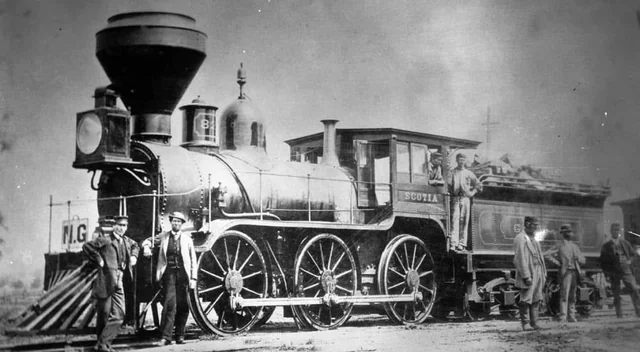
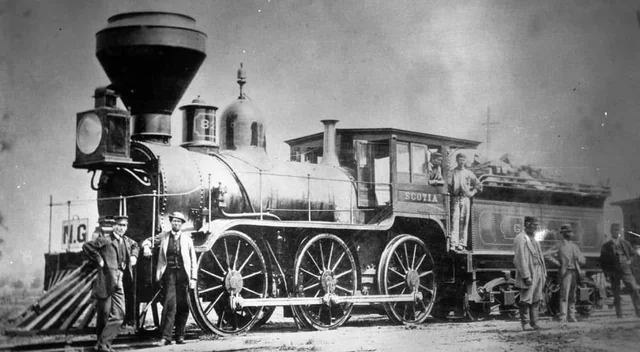
The engine was eventually taken to Parsons for repair. Two items were left behind at the scene of the accident: one was the smokestack that can be seen in pictures taken years later and the bell. Local railroad historian, Don Banwart, researched the bell to an auction. For years, a man named Charlie Yager kept the bell on a pole in his farmyard. The bell, polished and well kept, is now displayed in a shop in Smithville, Mo.
- Linda Baker
J.T Knoll can be reached at 620-704-1309, 401 W. Euclid, Pittsburg, KS, or jtknoll@swbell.net