PITTSBURG, Kan. — With more than 3,000 operations and 1,500 others in various stages of construction, the data center market is experiencing a large boom, rapidly growing all across the United States, including the Pittsburg and Four-State area.
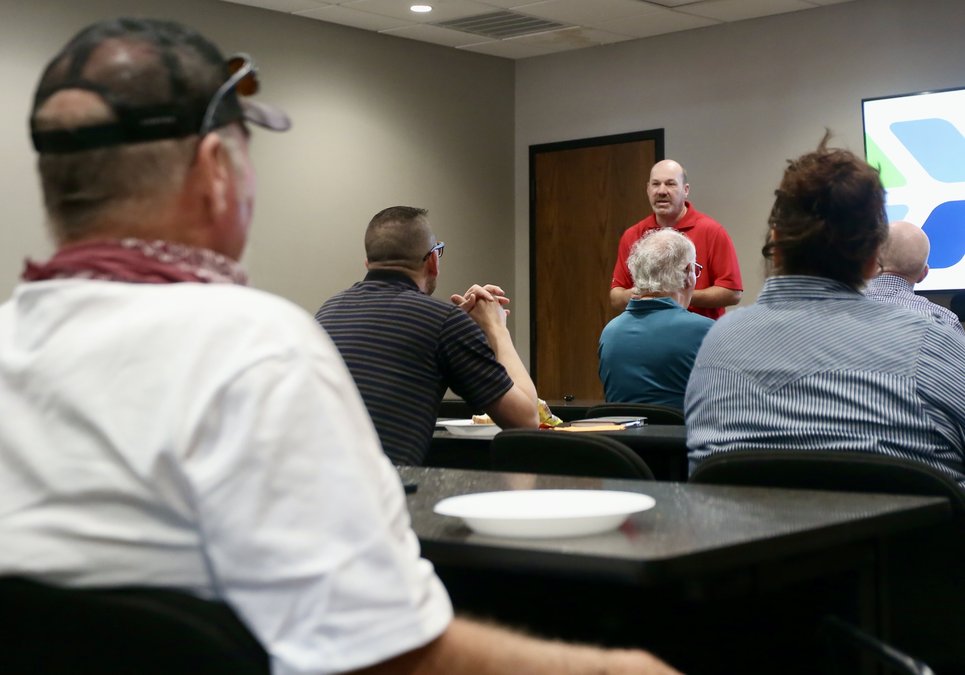
On Wednesday, Evergy Senior Director of External Affairs Jason Klindt addressed the concerns, benefits, and process of creating and maintaining a data center with local business and community members in the conference room of the Pittsburg Area Chamber of Commerce.
Klindt first discussed Evergy’s service territory, developments in renewable energy, and projects through the years before jumping into the data center discussion.
According to Klindt, 33 counties in the country account for 72 percent of data centers in the United States. Kansas and Missouri already have more than 30 smaller data centers operating today with a large concentration in downtown Kansas City, but neither state has a large data center.
Wildcat Data Infrastructure LLC currently operates a 10-megawatt data storage facility just northwest of Atkinson Municipal Airport off S. 200th St., which went online early this year. While a large amount of energy is being used, the facility generates sales tax and a franchise fee of 5 percent for the city.
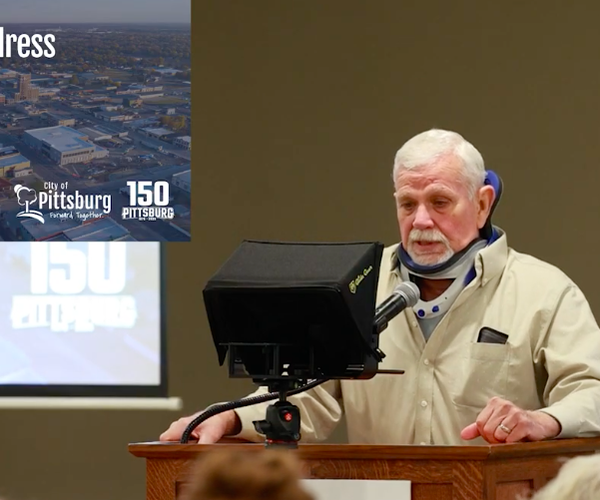
“Our local community uses about 25 megawatts a day, so this is 10 megawatts a day,” said Pittsburg City Manager Daron Hall. “So it’s a huge percentage of what we are already doing and the fact that we do get franchise taxes off of it and we get a sales tax off the power, it just helps that overall spread so we can get that tax burden down for the property tax.”
One of the main concerns about data center expansion is the use of resources such as water. However, according to Klindt, the Pittsburg facility is a closed loop system.
“I will hear a lot of times about the water that data centers use,” he said. “… When people are talking about the massive amount of water, that’s generally 20-year-old technology. Closed looped systems draw about the amount of two targets, and they just use it over and over and over. So generally, I don’t think there are a lot of data centers that aren’t closed loop systems anymore. Especially in Kansas, I wouldn’t want a data center that wasn’t a closed loop system.”
Pittsburg Chamber President Blake Benson then asked whether Evergy would lean more towards expanding upon a current facility such as Pittsburg’s or constructing a new one elsewhere.
“A bird in the hand is worth two in the bush kind of thing,” said Klindt. “… Data centers are having a heck of a time with location. You’re betting on something that is not a sure thing. So already having a data center and it’s expanding, generally it’s less infrastructure, generally it’s on-site all that is approved. That’s better than looking for an entire new site.”
When it comes to the benefits of data centers entirely, Klindt listed electric rates, tax revenue, competitive industries, job creation/personal income, and infrastructure investment. He noted in his presentation that data centers generate local tax revenue in excess of the local services needed, providing support for education, infrastructure, parks, and other needs.
“They actually have downward pressure on rates,” said Klindt. “So when Evergy Missouri Metro, on the Kansas City side, we have just filed for a rate increase there. However, we reduced the amount that we are asking from customers by $25 million based on one data center that hasn’t started operating yet. That’s how big of an effect they have.
“… Tax revenue, of course, we can talk about the property tax and you guys are well aware of that. Something you’re probably not aware of is what’s known as a franchise fee. So every city in Evergy’s territory has what’s known as a franchise fee with Evergy. So that means every time the meter spins, they (city) get a rip of the cost there … So five percent, when the meter spins, that means that’s money coming directly to the city. It’s their money.
“In one of my data center jurisdictions, the amount of money that the city is getting from franchise fees is $5.5 million a year and that’s only because they capped it. Had they not capped it, it would’ve been $15 million per year … A data center doesn’t have a lot of workers. It’s not something that causes the city to have to spend more money on that so it’s a nice boost for them.”
Klindt, a board member for a Kearney R-1, provided an example of how data centers are impacting his local area.
“The city next to us is the one that got the hyperscale data center in Kansas City,” he said. “Overnight, they turned around and boosted their teacher pay seven percent. So we are next to them. My choice is that I can either go and ask voters to raise taxes, or we can cut programs to be able to match that seven percent. So you’re seeing a definite impact on education as well as from the franchise fees.
“Competitive industry, I think this is a moment that’s probably not like others we’ve seen where infrastructure is being laid out. There’s digital infrastructure that companies want to be near.”
He also touched on Evergy’s Large Load Power Service Tariff (LLPS) program, which applies a tariff to customers with a load in excess of 75 megawatts. LLPS also requires a five-year transitional load ramp period plus a 12-year term length, totaling 17 years.
“Let’s say you sign up for 200 megawatts, but you are only using 100 megawatts, you are still going to pay for that because otherwise my customers are on the hook for that,” said Klindt. “You have a bad month, and you don’t make your minimum bill, that’s when it makes it really easy to bill. We just bill your minimum monthly payment. They are not paying the same kilowatt per hour price as others.”
He said the LLPS program saves residents funds by putting “downward pressure on rate increase requests” before discussing what is driving rates to increase.
Klindt said data centers are not the force driving electric rate hikes.
“It’s not data centers,” he said. “… That might be true in New Jersey or Virginia and some of those states. It’s less true in Missouri and Kansas and states like us. But what’s driving it is poles and wires. That’s what’s driving your electric costs … Just like a farmer who has to pay his inputs, I can’t get away from paying my inputs for steel poles, for all the metal, and all the stuff that I use. Those have gone through the roof.”
A chart that Klindt displayed noted that the price for a part such as a power transformer has gone up 158 percent in price since May 2020, taking 128 weeks to deliver. Another example is distribution automated switches, which have gone up 236 percent since 2020, taking 72 weeks to arrive.
Klindt addressed other concerns about data centers during a question-and-answer portion at the end of the event.
“Part of it is just sometimes the place they pick,” he said. “We’ve seen data centers that are away from the city that are out in the farmland. The reason by the way why they do that is data centers are trying to locate generally along those large transmission lines … That reduces their cost. If you don’t have to build a transmission line to it, then it’s cheaper.
“… The truth bats last and I feel like we’ve gotten a lot of things out there that I don’t know are always accurate … I wish there were other people doing the same thing who are maybe data center experts that would go out and talk to the public and just take questions. Before we get a project and everybody goes wild, I think it’d be helpful if folks were transparent and said ‘Hey, here’s what we are thinking about, here’s what it means.’”
This reporting is made possible, in part, by the Support Local Journalism Project Fund. Learn more at: southeastkansas.org/Localnews.