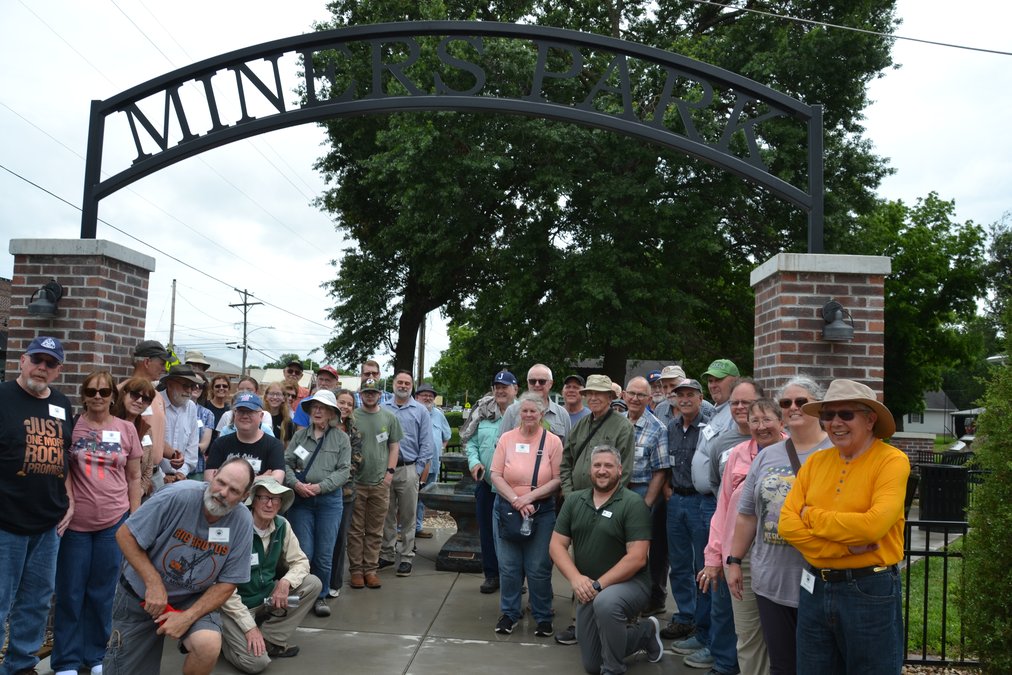
WEIR COAL FIELDS, Kan. — For the first time in the 36-year history of the Mining History Association, southeast Kansas took center stage, Thursday. Nearly 50 mining history enthusiasts from around the country — and even from as far as Tasmania and Finland — gathered in Pittsburg for a tour through the old Weir coal fields in Cherokee and Crawford Counties.
Thursday was the first of three days the MHA will spend in the area, traveling to several local sites, including the Heartlands Railroad Museum in Carona, Big Brutus in West Mineral, Miners Hall Museum and Dragline Park in Franklin, and the Heritage Hall and Miners Park in Frontenac. Thursday’s tour concluded with a stop at Highland Cemetery to visit the mass grave of the 1888 victims of the Frontenac Mining Disaster, followed by a quick pop over to Joplin’s History and Mineral Museum.
The tour group is an eclectic mix of academic historians, geologists, museum curators, and university professors who all share a deep interest in mining’s influence on technology, on labor-management relations, and on the diverse communities that grew up around those mines. Many have worked for the mining industry.
Some were amazed that many of the mining towns still exist. As one visitor noted, “Usually, when the mine leaves, the people aren’t far behind,” he said. “But not here. Here, they stayed.”
For Eric Clements, a professor of history at Southeast Missouri State University in Cape Girardeau, the most interesting things were the towns and the late 19th and early 20th century architecture that some have preserved. Referring to these towns in terms of an “urban frontier,” Clements noted that although the mines were located in remote places, their very existence created urban centers around them to house and support the mining operations.
Tracks had to be constructed to bring in supplies and haul out goods; homes had to be built for the labor force and their families; machine shops were built to service and repair the massive shovels and draglines and other machinery; boutiques, theaters, and stores sprang up to clothe, feed, and entertain employees.
“These mines built this country,” Clements said.
Klas Swanjlung, a museum curator from Finland, is on a working vacation for two weeks, travelling across the central U.S. while also taking in historic sites. The museum he oversees is near the site of the first modern mine in Finland that operated from 1910 to 1989. The company that owned the mine became a global player in mining and mining technology and equipment. The company even created one of the first trade schools meant to teach miners how to mine.
Swanjlung was impressed by the Frontenac Heritage Museum, saying it was his favorite stop on the tour and was full of advice for Library Director Seth Nutt. He found the fullness of the displays particularly interesting. In Finland, he said, his display would have one or two artifacts on a shelf; in America, it’s as many as will fit.
Many visitors were impressed with the care that goes into maintaining the local museums. Each one was a snapshot of a particular community at a particular time in history preserved for the future — like a communal family portrait.
These little museums tell our story. And it’s unique to us.
The conference doesn’t stop with Thursday’s tour as events are planned from 8 a.m. until 8 p.m., Friday and Saturday on the Pittsburg State campus at the Overman Student Center and Axe Library. The public is invited to attend.
On Sunday, the tour moves south into Oklahoma.